Customer Led Disruption in a Digital Era - Month 1
I thought that it'd be easier for me to just do a quick summary of the coursework month by month instead of week by week, because while I'm learning a lot, I don't really know how interesting it is.
I mean, it's interesting to me, which is good, because otherwise I'd be wasting that £12k, but to other people? Ehhhhhhh.
So this time, it's Customer Led Disruption in a Digital Era, which is pretty much all about how the consumer can change a business.
Which, y'know, yeah, of course, but it's nice to see the theories that are behind it. And it's a bit more example-based than the systems theory-heavy Disruptive Technologies in the Digital Economy, which also helps immensely (because, holy smokes, am I bad at remembering systems theory).
There's a lot more reading from Harvard Business Review than from academic papers, which is really nice, because more often than not, that's written in really basic English with a lot of examples, so they're smooth and easy reading.
Which makes my life easier, because when it gets to autumn? I turn into a bear and just want to hibernate.
Week 1: The Evolution of the Relationship Between Marketing, Customers, and Data
By the end of this week, you should be able to:
- Differentiate how customers, consumers and the data they generate vary
- Distinguish different types of innovation
- Conceptually describe the process of exploration and exploitation
- Explore the differences between traditional and consumer-centric managerial systems thinking
This week was a combination of understanding what Big Data brings to understanding consumers and how to bring in innovation into a company. There was a lot of talk about the "ambidextrous organisation", which is when you focus on the existing market you know while also experimenting with new markets and innovations. They call it "exploitation and exploration", but I don't know, dude, maybe we don't keep using the word "exploitation"?
There was also discussion of "incremental" and "radical" organisational change and how it relates to "disruptive" change. Which actually is good language to use, especially when something is happening in a company, because you can go "That seems like a pretty disruptive change to how we're doing business. Maybe we do it incrementally?"
My example was this: You're renovating your office. If you do incremental non-disruptive change, you slowly replace the desks with shiny new ones. If you do a radical non-disruptive change, you replace all the desks at once. If you do an incremental disruptive change, you slowly replace the desks with standing desks. And if you're going to do a radical disruptive change, you replace the desks overnight with treadmill desks. Fuck you, everyone's walking.
Also discussing Big Data helped me a lot to understand it more. I really liked that it was repeatedly pointed out that no matter how big the data is, it's all still old data, because you're not seeing what people are doing now, you're seeing what they did then. And, sure, the more data you have, the more you can analyse and maybe make a prediction or two, but it's still all based on what happened before, and when you're making radical changes to things, you can't predict much.
So tl;dr: Consumers are weird, try to be innovative, but not too much.
Week 2: User Generated Content and Open Innovation
At the end of this week, you will be able to:
- Explain the diffusion of innovation theory and the technology acceptance model
- Separate faithful and unfaithful appropriation of technology, and different types of user-innovators
- Describe the concept of technological affordances and how these matter for consumer led innovation
- Distinguish between closed and open innovation philosophies
Creative consumers? Unfaithful appropriation of technology? Open innovation?
Oh, you're speaking my language here! You are talking about absolutely everything I love about people and everything I love about maker culture, about fan culture, about people who take things businesses give them and make them better.
We're talking IKEA Hacks, we're talking fanfiction, we're talking turning your PS3 into a server, we're talking EMF, we're talking everything.
So, yeah, I was a little hyped up this week. And it was great to have the right language for what I have been trying to get companies to understand for decades now, all the way back to when I worked at Games Workshop and was trying to explain fan culture on the Internet.
They also brought in the idea of the Lead User, who is someone who the company can listen to as an innovation source external to the company, but what I've found is that, sure, this is someone who will be innovating your product, or doing more with it, but, once you bring them in, they're part of your closed innovation loop, and you're not really changing all that much.
My example was reseller hosting. You buy a hosting package, and then sell off chunks of that package to other people, saying that you're a hosting company. And more often than not, when we tried to get people in to find out what they wanted from a reseller package, we'd get Lead Users, people who were doing what we thought people would do with a reseller hosting package, and there wasn't that much we could do for them. Maybe update the selling software. Maybe give them a discount. But, really, there wasn't much they could tell us.
The Creative Consumers, who were doing different things with the reseller package? Those were interesting. And you couldn't get them via the usual survey/focus group/whatever method. You had to see where the activity was. You had to listen to people. Heck, you had to spot-check servers from time to time. And that's where you'd find people who weren't selling web hosting on, you'd find modeling agencies creating websites for their talent. You'd find digital scrapbook creators who just needed the space. You'd find all these things people were doing, and that's where you'd find what products were really needed.
Yeah, I had a great time with this one. I wish I could've gone deeper into it, but maybe I'll save that for the paper due at the end of this course.
Week 3: The Wisdom of Crowds
By the end of this week, you will be able to:
- Define the term 'business model'
- Distinguish between different types of crowdsourcing initiatives
- Recognise the opportunities and challenges of managing an organisational project that deals with a crowd
- Investigate the substantive nature of acquiring and assimilating knowledge in a co-created project
This was a bit of a odd blend, because while we were continuing on with creative consumers in the form of crowdsourcing, we were also learning about business models and absorptive capacity, which is how a company takes in information and uses it.
A chunk of the other students went straight into crowdfunding, but I brought in Open Source Software and how it's a huge crowdsourced movement that most businesses are more than happy to use. I mean, shoot, you run a web server that uses Linux, and you're already taking advantage of a whole herd of people who have donated their time and energy to building your innovations.
I liked learning about absorptive capacity and the process by which companies take in new information – I think that could be an interesting way to introduce new concepts to businesses, especially when you're trying to sell upper management on not going for the latest fad but trying something they ignored in the past.
(The number of times I said "Why aren't we sending more detailed and tailored emails?" when they were going "Google ads! Meta ads! Videos! More videos!"... swear to god. And what worked? The freakin' emails.)
Week 4: Understanding and Mapping Consumer Journeys
At the end of this week, you will be able to:
- Distinguish between different offerings and articulate why experiences matter more than products and services today.
- Discuss design thinking and the benefits, but also challenges, of designing experiences.
- Incorporate human-centred research into your research and/or experience design activities
- Articulate the importance of empathy and journey mapping
Initially, I thought this would be about actually mapping a detailed customer journey, like I have in the past with automated emails and triggers and whatnot, but it was actually a lot more about looking at what customers wanted, building the experience around that, and their pain points.
And design thinking, which is delightful.
Design thinking is just looking at problems from a designers' point of view, constantly experimenting and resetting and restructuring the problem.
Some of it was a bit Silicon Valley bro culture, unfortunately, especially since we were getting stuff from the Stanford Institute of Design (which calls itself "d.school" and...ugggggggh. oh my god, stawp.)
And, like, design thinking is good. It has five steps:
- Empathise
- Define
- Ideate
- Prototype
- Test
And then you repeat and repeat and repeat.
The problem, especially with the design bros, is that you forget the first one and keep on focusing on the last three. That's the whole "move fast and break things" bullshit that got us into... gestures loosely at the world.
The reading focused on bringing in the "soft sciences", anthropology, sociology, philosophy, into business, which, yeah, I'm entirely for, and I love it to pieces.
I just wish more businesses would just have a little more empathy, y'know?
Month One — Results
- So far, so good.
- Ambidextrous organisations mix exploitation and exploration into their business plans.
- Exploitation is a terrible word.
- Creative consumers are awesome.
- Lead users are just repeating what you want to hear.
- Absorptive capacity is how your company takes in new information.
- Design thinking is great.
- Empathy is even better.
- God I hate "d.school".
What's coming up in the next month? Gamification, platform businesses, consumer and consumption data, chatbots, netnography, and writing a paper where I "...concentrate on how a particular firm or industry currently struggles to understand and engage with customers effectively, and consequently does not consider consumer-preferences effectively."
God, where do I even begin?
Today's Sticker
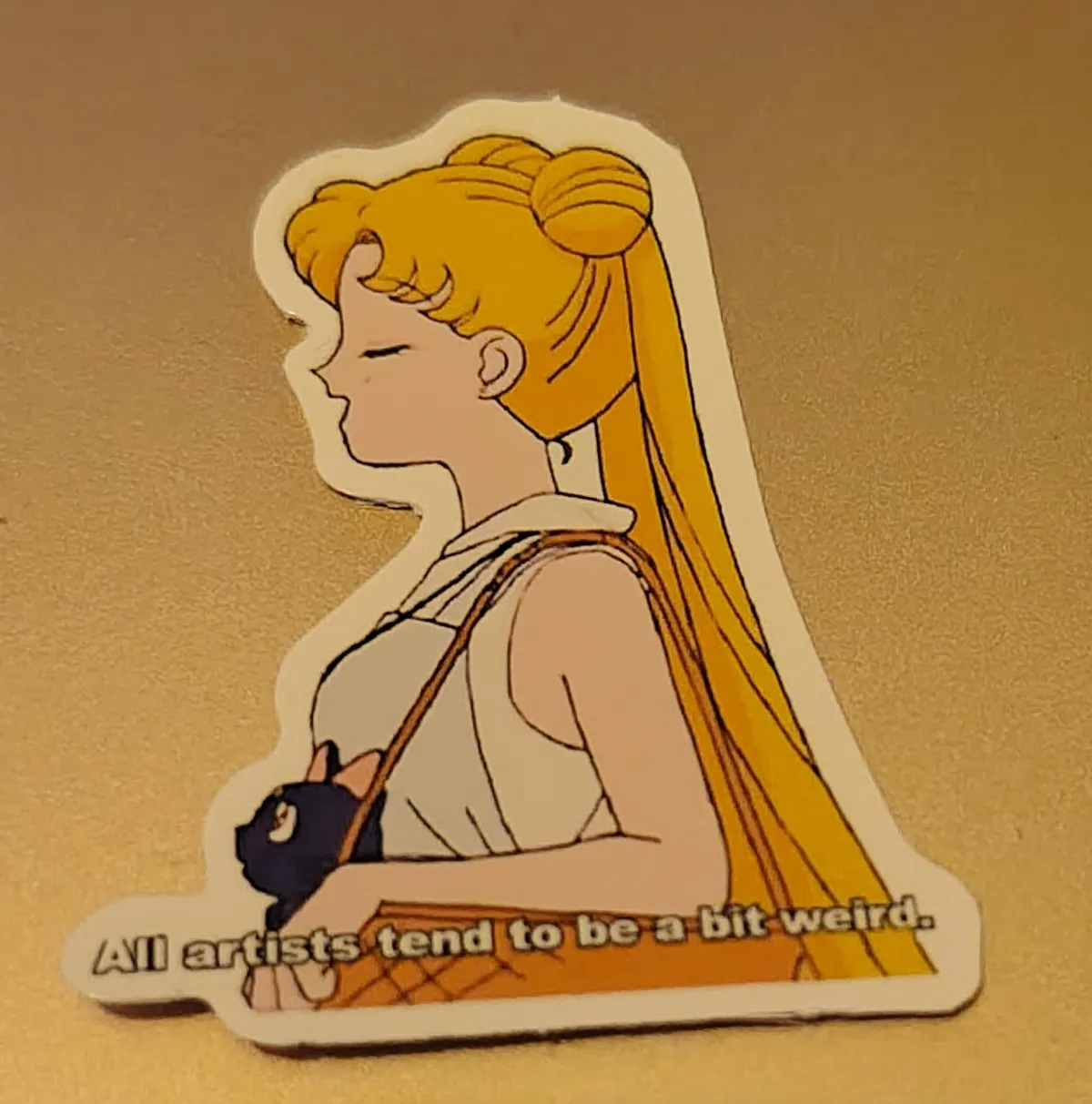
You tell 'em, Usagi.
This was part of a Shifty Thrifting letter telling me to switch to their Ko-Fi Sticker Club instead of the one using their previous supplier. I was happy to move, I am delighted by the sticker club, I'm not going to say "there are five places left what are you doing", but I kinda am?
You love stickers. I can't be the only one who does.
References
- Berthon, P.R., Pitt, L.F., McCarthy, I, Kates, S. M. 2006. When customers get clever: Managerial approaches to dealing with creative consumers. Business Horizons. 50(1)
- Dahlander, L. and Piezunka, H. 2020. Why crowdsourcing fails. Journal of Organization Design. 9(24)
- Dunne, D. 2018. Implementing design thinking in organizations: an exploratory study. Journal of Organization Design. 7(16).
- Eisenberg, I. 2011. Lead-user research for breakthrough innovation. Research Technology Management. 54(1).
- Hofacker, C.F., Malthouse, E.C., and Fareena Sultan, F. 2016. Big data and consumer behavior: Imminent opportunities. Journal of Consumer Marketing.
- Madsbjerg, C. and Rasmussen, M. 2014. An anthropologist walks into a bar... Harvard Business Review 92(3).
- O'Reilly III, C.A. and Tushman, M.L. 2004. The ambidextrous organization. Harvard Business Review. 82(4).
- O'Reilly III, C.A. and Tushman, M.L. 2013. Organizational ambidexterity: Past, present, and future. Academy of Management Perspectives. 27(4).
- Ovans, A. 2015. What is a Business Model? Harvard Business Review. https://hbr.org/2015/01/what-is-a-business-model [Accessed 24 October 2026].
- Zahra, S.A. and George, G. 2002. Absorptive capacity: A review, reconceptualization, and extension. Academy of Management Review 27(2).