Disruptive Technologies in the Digital Economy, Week 1 – Information Systems Failures and the Technology Horizon
I figure if I go over my notes on the readings, lectures, and exercises for each week, I'll get a better understanding of what it is I'm doing, and y'all will hopefully learn a little bit too.
Of course, this relies on me not having a bad cold during a heatwave, where if the night-time heat rising from all the tarmac and brick surfaces around you doesn't keep you up, the incessant coughing will.
Ugh, I am so tired. But I survived my first week.
Weekly Learning Objectives
By the end of this week, you will be able to:
- Differentiate between information technology and information system.
- Deconstruct and evaluate the organisational characteristics that can lead to failing technology implementations.
- Abstract from the fundamental failure-vectors into general technology-based reasoning.
- Interpret the constructs of the Technology Acceptance Model and reflect on their interactions.
Are you having a hard time with the academic language? Yeah, I did too. I'm generally okay with it, but, man, sometimes I just tune out and you can see the little "loading" wheel turning in my brain.
But, basically, what I need to know is:
- What's an information system, rather than information technology?
- What organisational issues can lead to technology projects failing?
- How can you apply those issues into a wider reasoning?
- What's the Technology Acceptance Model and how does everything interact?
Information Systems
There wasn't a single definition of what an information system is, at least, not in any of the reading or any of the discussions. Everyone had slightly different ideas, but I think I know how I'm going to describe it.
Information technology is the stuff you bring in and use. It's the computer. It's the software. It's the architecture.
Information system is what you need to do and how you use it. It's what you need to install before you can use your laptop. It's integrating the new software with your current setup. It's making sure you have the right architecture in place before you switch over to it. It's how people, processes, and technology all work together.
And of course it can all go wrong. We see that every day. But we need to figure out how it went wrong, and then pull back even further to understand the wider issues so that, in the future, we can stop those failures from happening again.
Like, when the new website doesn't launch in time because the dev team have decided to try a new framework without telling everyone else, you don't just blame the dev team, move on, and then get surprised when it happens again and again because everyone has a hot new framework. You look at why they're choosing these frameworks, why they're not telling people about them, and why they keep on being used on full site rebuilds. You look at what needs to be done in your entire workflow and find solutions so that the next time you're like "We're making a new website", your team can go "We'd like to try this framework" and you can work out how to effectively try a new system without breaking everything.
Research on information systems failures and successes
The essential reading for this week was "Research on information systems failures and successes: Status update and future directions", by Yogesh K. Dwivedi et al, published in Information Systems Frontiers 2015.
(As part of my coursework, I also have to learn how to use University of Hull-style Harvard Referencing, which is going to destroy me, because I am so used to footnotes. But, on the other hand, it is easier to build into a page. You can find the full reference list at the bottom.)
In this paper, panelists speaking in the "The Information Technology Paradox: Why Some Companies Succeed and Some Fail?" at the 2013 International Federation for Information Processing Working Group 8.6 (Transfer and Diffusion of Information Technology) conference pulled together their thoughts on some of the things that were coming up in their study of information systems, and where things could go further.
There were a lot of references to other papers focusing on what constitutes success and failure, but by combining Petter et al (2013) and Nelson (2007), the panel decided on three overall areas:
- People
- Organisation
- Technology
You need all three to make it work, and all three can make it fail.
The panelists then had separate sections of the paper to talk about their research.
Elbanna focused on developer, project management, top-management, and user perspectives, pointing out that different groups have different ideas of what success and failure look like.
Bunker was working on how information systems work within disaster management systems, when everything needs to be done quickly, accurately, and changes from disaster to disaster.
Myers focused on the conventional wisdom for IT implementation, and how it should be reviewed and studied in order to achieve even more success in IT projects.
Srivastava brought in a government perspective, pointing out that a lot of the research has focused on business, where the objective is usually profit. But government projects might have many different objectives, and some of them might be competing against each other.
Ravishankar also looked at government projects, and how future research of government projects needed to look at the wider picture. That you can't measure success purely by whether or not the individual project is a success, but by how the other systems it interacts with can work with the project.
All of them brought in a lot of great information about what needed to be researched when it comes to information systems, and how "success" and "failure" can really mean anything.
User Acceptable of Information Technology
The recommended reading was "User Acceptance of Information Technology: Toward a Unified View" by Viswanath Venkatesh et al, published in MIS Quarterly 2003.
This paper brought in the idea of a Unified Theory of Acceptance and Use of Technology (UTAUT), which is one great big model to plug in all your variables when you're creating a project.
It took eight different models and theories of how people accept new technology into their lives and the things that affected those models, plus reviewing all the studies that used those models as a basis. And, after all this research, they came up with this model:
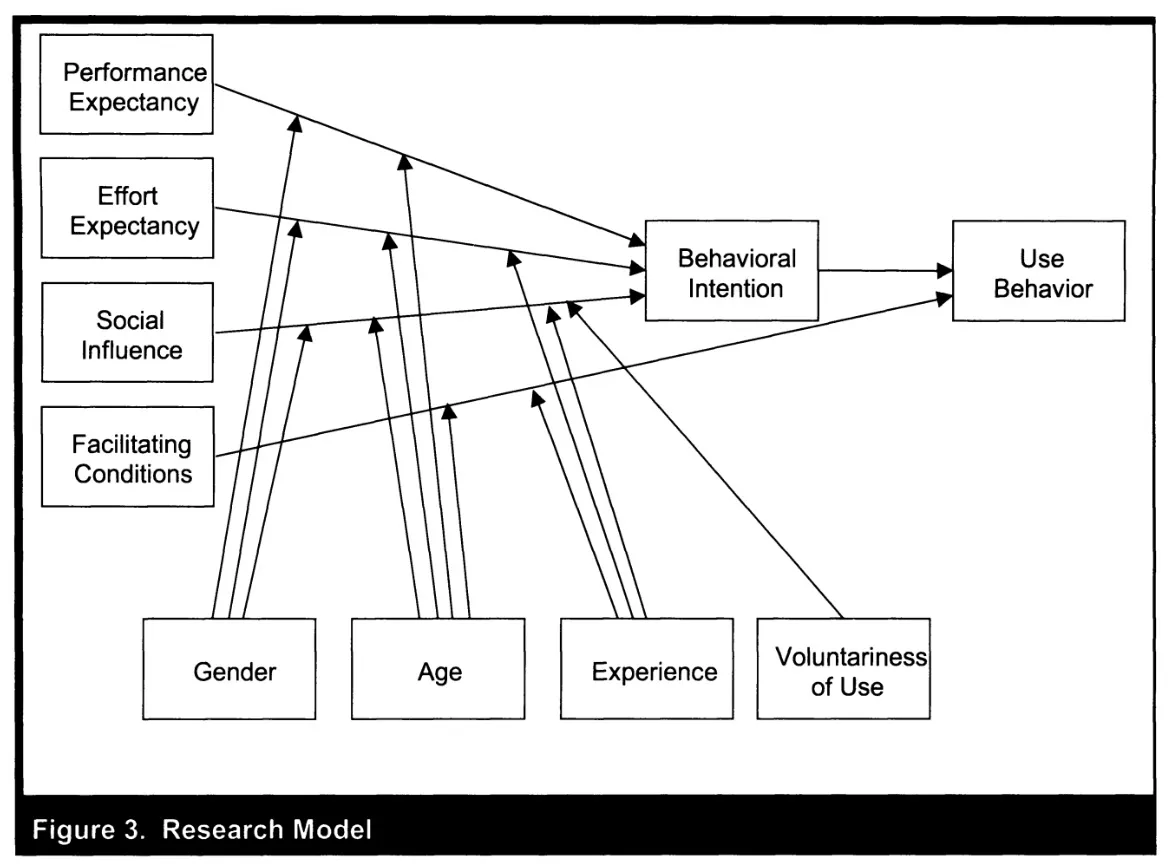
(Venkatesh et all 2003:447)
Basically, people want to use new technology because:
- How they think it'll affect their performance
- How easy they think it'll be
- How other people will view them
Their gender, their age, their experience, and how voluntary it is to use the technology affect these three reasons. What doesn't affect their desire to use the technology are how well using the technology is brought in, like training and support. That affects the use of the technology, but not whether or not they want to use it.
(I think there could be a really good study done on trans identity and technological uptake. I need to see if other people have done this.)
Digital Transformation Research
The background reading was Nadkarni & Prügl's "Digital transformation: a review, synthesis and opportunities for future research", published in Management Review Quarterly 2020.
I actually read all of this thinking it was the recommended reading, all 109 pages of it, and then discovered I had 55 pages of actual recommended reading to get through, but you know what? I actually really liked reading this, and I found it interesting.
They did a full literature review of digital transformation, and how this fits into two major dimensions:
- Technology (the thing that does the work)
- Actor (the people that do the work)
And then there are additional themes for each dimension – the things that make the technology and the actors actually work.
Technology
- How fast technology changes and how fast you can take it to market
- What the technology is capable of and how well it integrates with existing systems
- How consumers or other stakeholders interact with technology
- When value appears in the technology and what is captured within
- What is the market like and what is the competition like
Actor
- How leadership reacts to technology
- How capable the management and systems in place are
- How the company culture can adapt
- What kind of work environment the technology is coming into
They also got into things that needed to be researched further when it comes to digital transformation. The role of middle management was a big one, as they're usually the ones stuck implementing everything. The inevitable generational skills gap that keeps popping up. And how startups, pure tech companies, and hybrid companies cooperate.
The Technology Horizon
Finally, there was a lecture from our course instructor, Dr. Diego Navarra. He wanted us to approach technology from a business and societal perspective, getting everyone to think about context and broader consequences.
ICT is an enabler, giving organisations the tools they need to develop new ways of transacting and interacting.
And technology doesn't work in a void. There's context that needs to be considered, such as:
- Social
- Legal
- Political
- Economic
- Ethical
One thing that didn't get mentioned, but that I'm still wondering about, is what happens the technology is not what everyone's been told it is.
For example, in the lecture, Dr. Navarra included the commercial for Amazon Go, which was where they said that machine learning and the like would let you go into a grocery store, pick up what you want, and you'd be automatically checked out without having to deal with people or go through a process.
But as was discovered by Theo Wayt for The Information, around 70% of the time, it wasn't AI that was tracking what you picked up, it was a team in India watching you on CCTV, keeping track of what you took with you so you could be charged correctly. (Wayt, 2023)
So what I'm wondering is that you can plan for all of these reasons why a digital transformation in a company might fail, you can make all these decisions based on what you know you're doing, but has anyone actually researched what happens when it turns out that the technology you've been sold is a lie?
I might dig further into that.
Week 1 — Results
- Information systems are how people, processes, organisations, and technology all work together.
- IS success and IS failure can mean a lot of different things, depending on what you're doing.
- You can apply a unified theory of technological uptake, if you take in account how their gender, age, and experience affect them, and whether or not it's voluntary.
- You can break everything down into "The thing doing the work" and "The people doing the work".
- Context and consequences are very important when it comes to thinking about technology.
- Harvard Referencing is very painful but I will learn it.
- Things now have Digital Object Identifiers, which is pretty cool.
Ooof. I'm sorry, this was a lot to take in. Think about me, with my cold, in a painfully hot British mid-terrace house, trying to pay attention to all of this too.
I like it, I really do, but, dang. It's a lot. I need some basic JavaScript in my life to make things make more sense.
And I never thought I'd be saying that.
Today's Sticker

Another fantastic Lino Folk sticker, this time a lit Hand of Glory, which, I guess, is technology. Of sorts.
It was said to unlock any door it came across, so...yep.
References
Dwivedi, Y., Wastell, D., Laumer, S., Zinner Henriksen, H., Myers, M., Bunker, D., Elbanna, A., Ravishankar, M., & Srivastava, S. (2015) Research on information systems failures and successes: Status update and future directions. Information Systems Frontiers, 17(1), 143-157. https://doi.org/10.1007/s10796-014-9500-y
Petter, S., DeLone, W., & McLean, E. R. (2013). Information systems success: the quest for the independent variables. Journal of Management Information Systems, 29(4), 7–62. https://doi.org/10.2753/mis0742-1222290401
Nelson, R. R. (2007). IT project management: infamous failures, classic mistakes, and best practices. MIS Quarterly Executive, 6(2), 67–78.
Viswanath Venkatesh, Michael G. Morris, Gordon B. Davis and Fred D. Davis Venkatesh, V., Morris, M. G., Davis, G. B., & David, F. D. (2003) User acceptance of information technology: Towards a unified view. MIS Quarterly, 27(3), 425-478. https://doi.org/10.2307/30036540
Nadkarni, S. & Prügl, R. (2020). Digital transformation: a review, synthesis and opportunities for future research. Management Review Quarterly 71, 233-341. https://doi.org/10.1007/s11301-020-00185-7
Introducing Official, (2020) Amazon Go – World's most advanced shopping technology | INTRODUCING OFFICIAL [Video]. https://www.youtube.com/watch?v=-4RBWACdHLU [Accessed 29 May 2026].
Hayt, T. (2023) How Amazon's big bet on "Just Walk Out" stumbled. The Information, Internet edition. 9 May. https://www.theinformation.com/articles/how-amazons-big-bet-on-just-walk-out-stumbled [Accessed 29 May 2026].