Disruptive Technologies in the Digital Economy, Week 2 – Technology and Organisations
Oh my God talk about throwing people into the deep end here. Even though most of it was fine and most of it made sense, there were some bits this week that were absolute murder for anyone who is coming back to academia after decades.
Weekly Learning Objectives
By the end of this week you will be able to:
- Understand the basic levels and principles of Business Process Re-engineering and their significance.
- Differentiate between traditional organisations and digital natives in how IT-orientation occurs.
- Reflect on the broader fundamental transition from human decisions to automated decisions.
- Explore the dynamics of the digital economy through the co-evolution between physical and social technologies.
Honestly, I'm not sure I actually got any of that from this week, but I did get a lot of stuff that was good to know.
Digital Transformation and IT Organisational Transformation
The big thing, really, in all the reading, was the difference between Digital Transformation and IT Organisational Transformation.
Wessel et all (2021) describes them like this:
IT Organisational Transformation is where you bring in new technology, but your organisation pretty much stays the same. What you do stays the same, what happens stays the same, you just do it slightly differently because you have technology.
Digital Transformation is where you bring in new technology, but you also redefine what you do as an organisation. The technology changes what you are, what you do, what you're going to do.
A good example, actually, is Amazon.
See, initially, it was just for selling stuff on the Internet. You're buying a book, it's just like how you're buying a book in a physical store, but now you're doing it online.
But when they moved into cloud computing, that changed the company. It's no longer a place where you buy stuff, it's powering a ridiculous amount of the Internet (Ritcher, 2026)
So when technology comes in, you need to figure out if this is going to be something that is going to reinforce what your company does, or if you need to change what the business is.
Another example I have, just a tiny bit of ridiculousness I came across once... I interviewed at a web design agency back in, like, 2004 or something. Ages ago. And I had a really hard time finding the office, because it was in this industrial area.
It turned out that the main company was a lingerie factory. They had big machines making stuff all over the place. But because it was family-owned, one of the sons of the owners wanted to start a web design company. So they started one, under the same name, and it was...somehow part of the same company. So you could get girdles and a website in one go.
Yeah, I don't know how that works out. But I just looked up the company and, surprisingly, the web design aspect is still going strong, so, yeah, digital transformation there.
Routines, processes, and digitalisation
Part of the reading this week was "Digitalization of Work Systems — An Organizational Routines' Perspective" by Wolf, Bartelheimer, and Beverungen, and, oh, let me tell you, this is what killed all of us. Once you dug down into it, you understood what they were talking about, but you had to do a lot of digging.
As an example, here is one paragraph in the paper:
Ostensive and performative aspects are mutually constitutive since ostensive aspects are the social structure that enables and constrains human actions, while the performance of a routine produces and reproduces the ostensive aspects through recurrent enactments [30]. The similarity or dissimilarity of the ostensive aspect and the performance of a routine indicates a change [23]. Each iteration of a routine can differ from the previous one, leading to an endogenous change of the overall routines [22]. Actors can decide to deviate from ostensive structures consciously or unconsciously through human agency [53].
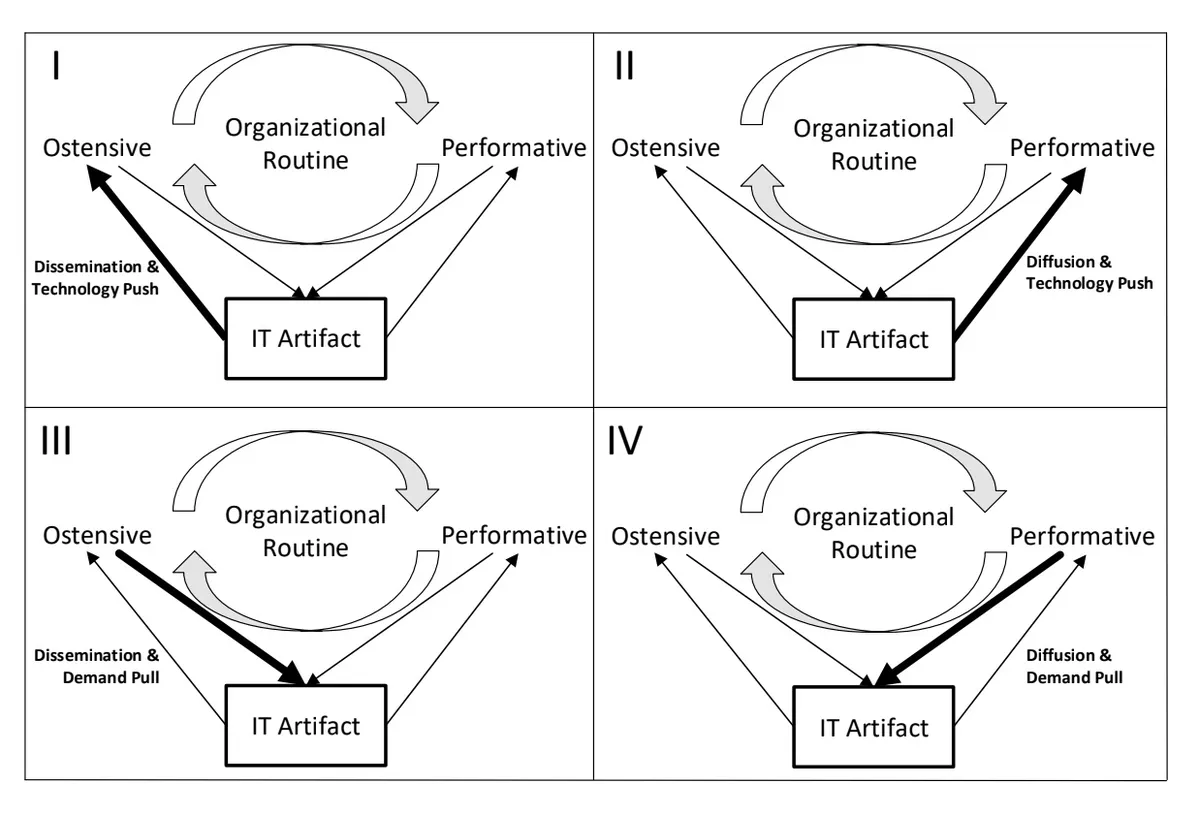
And this is their main diagram in the paper
Yeaaaaaaah.
I did manage to more or less figure out what they were trying to say.
Digitalisation is when you apply the idea of digitisation (moving things from analog to digital) to broader social and institutional contexts.
Sure, you can move from a typewriter to a word processor, but what does that mean for your organisation? How does that change things? That's what digitalisation is.
There are routines in work systems. These are the things you do to do the work.
There are two types of routines:
- Ostensive is the idealised theoretical way the routine goes. If you're sending out a package, this is the set of instructions you have to do the work.
- Performative is how the routine actually gets done. Sometimes it's just like the ostensive routine. Sometimes it goes all wrong and it goes differently. But you're getting those packages out.
And that great big figure above is how digitalisation can go when it's applied to work routines. There are four patterns it can follow, and, to make it easier to understand, let's do an example. Let's do Grammarly, or whatever the hell they're calling it now.
Pattern 1: The management is fed up with all the typos in support tickets, and insists that the Grammarly plugin is installed on all the computers on all the browsers, and pays for this to happen.
Pattern 2: Employees know they have problems with typos in support tickets, and they use the site version of Grammarly to check before they post anything. It's an extra step in the routine of answering a ticket, but it's immensely helpful, and it starts spreading out across the company.
Pattern 3: The company loves having well-written tickets, but is a bit worried about company data being on Grammarly's servers. It works out a nice little homebrew version that gets set up on the network for everyone to use.
Pattern 4: Employees know they have a problem with typos, and start installing the Grammarly plugin on all their browsers. Management only finds out when someone goes "Hey, um, does this count as a data breach?"
Creating Digitalisation in the Workplace
Another one of the readings we had was Guinan, Parise, and Langowitz's "Creating an innovative digital project team: Levers to enable digital transformation". Which was, basically, "you know you're gonna need a team to do all of this, so how do you make sure you have a great team?"
And I loved this. I kept going "Yes, yes, YES this is what I have been SAYING why don't you LISTEN to me".
You need to have four things in place to have a successful digital project team:
- A diverse and targeted team composition
- Iterative goal settings
- A continuous learning approach
- Talent management
You need to get everyone involved (diverse & targeted team composition), regularly checking in and changing goals (iterative goal settings), in a safe and comfortable exploratory environment (continuous learning approach), with the people you need when you need them (talent management).
They also had a great quote:
...digital IT cannot be separated from strategy, new product development, operations, finance, and/or marketing.
Goddammit, YES, stop bringing in Marketing when the product is just about to launch, get us involved at the goddamned beginning so that we can make sure it works.
Systems theory and digital systems
In the lectures, we had a quick dash through systems theory, which is some hefty stuff to be throwing into a 15-minute lecture, let me tell you.
But, basically, everything is a system, and the system exists in an environment. The system has a boundary between it and the environment, and it adjusts its boundary to feedback from the environment to ensure it gets what it needs from the environment.
All systems inevitably move towards entropy, but they can work towards being negentropic — stable in the environment.
Yeah, part of me wants to call this biological essentialism for business majors, but, hey, it works.
We were asked to create a system diagram of Uber, to show how a digital organisation responds to the environment it's in.
I managed to refrain from just posting this
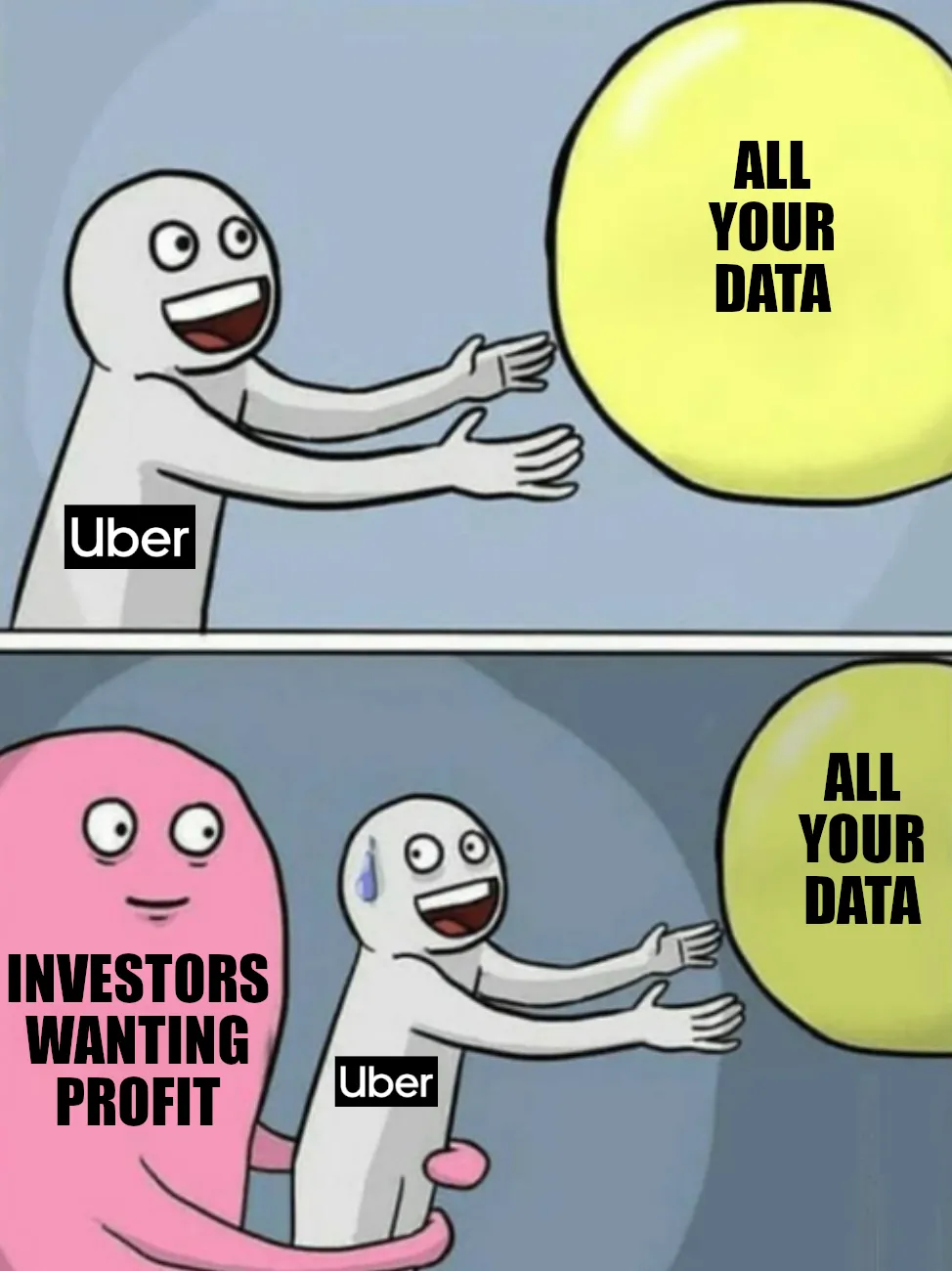
But, god, was it tempting.
Week 2 — Results
- Systems theory is that everything is a system, just trying to keep itself stable in its environment.
- Digital transformation is when that system brings in technology that revolutionises what it is as a system.
- Digitalisation is when you look at digitisation from a much larger picture, and how it affects everything.
- Work routines can be ostensive (how they should go) and performative (how they really go).
- Bringing technology into work routines can fall into four patterns, all with their own problems.
- The best way to avoid problems is to have a great team.
Next week, we start looking at some of the more disruptive technologies that have been emerging, and, thank god, we're starting with 3D printing. This? This I can cope with.
Today's Sticker

UNBOTHERED. MOISTURISED. HAPPY. IN MY LANE. FOCUSED. FLOURISHING.
Little Pink Goblin's Bathing Capybara is me after I finish doing all my reading and now I am just...at peace.
References
Wessel, L., Baiyere, A. Ologeanu-Taddei, R., Cha, J., & Jensen, T. (2021) Unpacking the difference between digital transformation and IT-enabled organizational transformation. Journal of the Association for Information Systems 22(1), 102-129. https://doi.org/10.17705/1jais.00655
Richter, F. (2026) Big three hold dominant lead in accelerating cloud market. Statista. 5 May 2026 https://www.statista.com/chart/18819/worldwide-market-share-of-leading-cloud-infrastructure-service-providers/ [Accessed 2 June 2026]
Wolf, V., Bartelheimer, C. & Beverungen, D. (2019) Digitalization of work systems — An organizational routines' perspective. 52nd Hawaii International Conference on System Sciences. https://doi.org/10.24251/HICSS.2019.724
Guinan, P., Parise, S. & Langowitz, N. (2019) Creating an innovative digital project team: Levers to enable digital transformation. Business Horizons. 62(6), 717-727. https://doi-org.hull.idm.oclc.org/10.1016/j.bushor.2019.07.005
Venkatraman, N. (1994) IT-enabled business transformation: From automation to business scope definition. Sloan Management Review 35(2), 73-88.