Disruptive Technologies in the Digital Economy, Week 3 – Printing, Reality, and Disruption
This week was pretty disappointing in some aspects. Like, since the reading was 3D printing-heavy, I was hoping for some serious discussion on that, but it ended up being really all about augmented reality in the "don't look at the world, look at your phone" way and that is hella disappointing.
Weekly Learning Objects
By the end of this week you will be able to:
- Reflect on the transition from old forms of technology to new forms and what these changes will mean for businesses and customers alike.
- Experiment yourselves with technologies like Augmented Reality and Virtual Reality and deconstruct their use and potential by using theoretical models.
- Understand the implications that such technologies can have for e-commerce and the digital economy.
- Critique Augmented Reality and Virtual Reality while assessing their potential appeal.
Yeah, I managed to get that done. And believe me, my criticism was mighty.
3D Printing
This? This I know. This I understand. This is something I have seen way too often and every once in awhile, someone goes on about how it's going to revolutionise the manufacturing process, and it's definitely still not there yet.
So both of the papers we read on it were from the 2010s, so this was back when everyone really thought 3D printing was going to take off.
And it has, just not in the way people were hoping.
A big thing, especially in the Petrick & Simpson paper (2013), was that we were moving from economies of scale to economies of one.
Economy of Scale is how our current way of manufacturing and sales work. You get low-cost high-volume products, with a sequential supply chain structure, and the designs are limited by manufacturing constraints.
The raw materials go to the manufacturer, who has specific machines that make specific things, then those products are sent to the wholesaler, who sells them to the retailer, who sells them to the consumer. The design is limited by what the machines can do, there are definitive competitors because you're all making the same thing, and stuff like that.
We've all seen it in action. It's why companies start ordering Christmas stuff in June, it's why major trends happen, it's all large-scale stuff.
Economy of One, on the other hand, is a lot less linear, with a lot more interaction between the manufacturer and the consumer. Consumers work with manufacturers to customise their design — and we're not just talking, like, embroidering your name on your hat. We're talking whole new hats here.
The wholesaler and the retailer are removed from the equation, and often, the manufacturer itself is removed, because the consumer becomes the manufacturer, going from their design to their products, making their own things.
This also came up in the recommended reading from Rayna, Striukova, & Darlington (2015), who looked at online 3D printing platforms, including Thingiverse. They studied how online platforms like these also changed how consumers interacted with manufacturing, and how there could be co-creation and innovation and the two things were very different things.
Co-creation is when you make something, especially something based on an existing pattern, and just follow the pattern. Like a table. Or a shawl. Or a 3D-printed pencil holder. Yes, you're making it yourself, but it's still based on that pattern.
Innovation is when you create something new, maybe from that pattern, maybe not. You turn the shawl into a cardigan. You add new decorative elements to the table. You turn the pencil holder into a knife holder. You're creating new things based on existing things.
But both papers really focused on how 3D printing would change things, and I think it really says something that the way most people interact with 3D-printed products isn't through innnovative medical care or bespoke tools or constructed buildings or handcrafted designs, but, instead, bulk-manufactured toy dragons.
We were supposed to use 3D printing to destroy traditional manufacturing process, and, instead, we've just swallowed it up into the way things are.
That's late-stage capitalism for you, I guess.
All the different realities
The other bit of reading we did, plus what the coursework, lecture, and discussion was focused on was virtual, augmented, and mixed reality.
And for a huge chunk of this week, I was just incredibly depressed. Because it wasn't anything interesting, it wasn't anything particularly useful, it was just the same shitty "I can look at my phone and see even more detail!"
It was Google Glass. It was Pokémon Go. It was the Metaverse. It was all this nonsense that has you engaging with everything but what's in front of you.
Okay, yeah, the paper (Farshid, Paschen, Eriksson, & Kietzmann, 2018) was interesting, and they were also obviously great big Trekkies trying to get everyone to get hyped up about holodecks, but...
On a regular basis, I used to get design agencies trying to sell me augmented reality advertising and pages. They kept on going on about how innovative it was. About how it'd get people involved. How it could really make us known in the world.
We. Sold. Web. Hosting.
How the fuck do you augment reality about that? They're not going to the data centre. They're not looking at a screen and going "Oh, yes, this is a powerhouse of a server, perfect for hosting my badly programmed e-commerce site on it!"
And before that, I was briefly working in higher education, and this was back when Second Life was hot, so everyone kept on going "We can have a virtual campus! Where students meet! Virtually!"
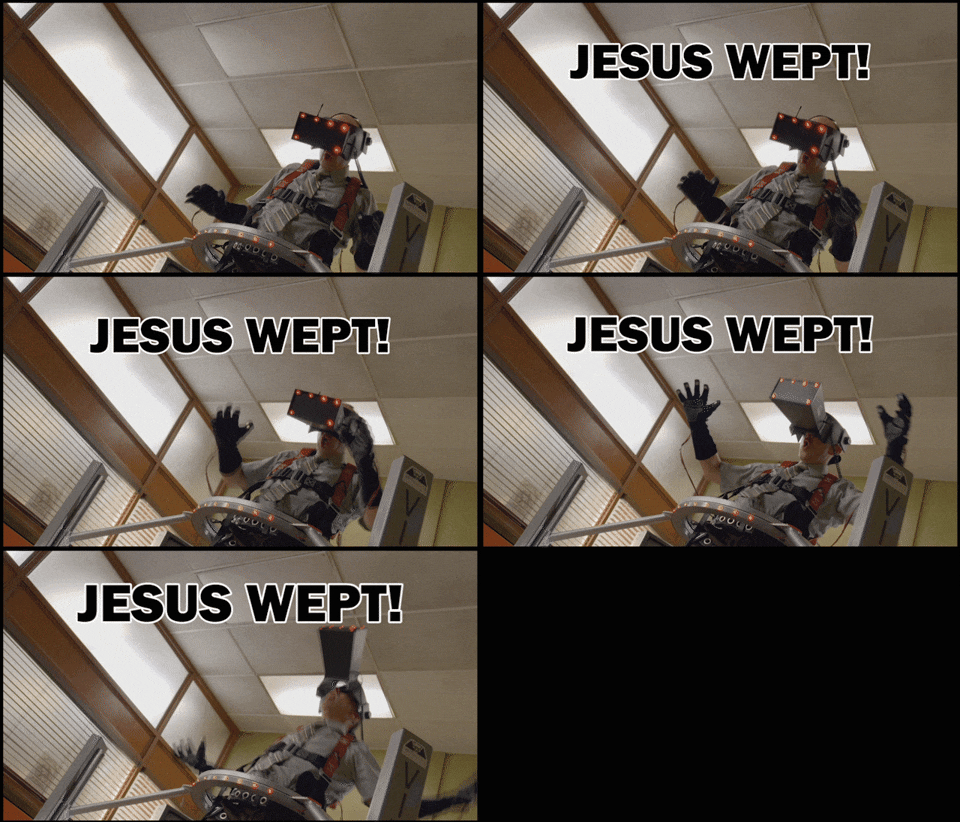
(Honestly, I would've done a lot better working at Greendale.)
So I am incredibly cynical when it comes to a lot of the "reality" concepts, especially with business.
But then I started thinking about it. And things I've seen. And what these things were.
And, like, there's a lot out there that is actually augmented reality that we don't think of as augmented, because it's not looking through your phone.
An audio tour through an art exhibit is augmented reality. A video overlay on the side of a building is augmented reality. Hell, Odorama is augmented reality. You're adding an extra layer of information on top of what people are experiencing.
And that's a hell of a lot cooler than looking through your phone to see advertisements for the shops around you, which is what people keep on hyping up. And, y'know, I'd much rather have a stone relief come to life than my game data turned into military strikes.
One of the activities this week was to download and use three different augmented reality apps on your phone.
Unsurprisingly, I said "No. I'm not going to do that."
Disruption and technology
The lecture was two hours and started with a quick dash through the history of the Internet, then moved to how technology in business now has three types of systems.
Calculation systems are single-purpose systems designed to do one thing and do it well. So, like, payroll. It's designed to take in the employee data, crunch some numbers, and pop out payments.
Functional systems are multiple-purpose systems designed to improve organisation in the business and merge together a bunch of calculation systems. Like HR software. It has payroll in there, but it also has the holiday system, and training, and onboarding. It brings in more complexity, and you run the risk of a bunch of different functional systems duplicating data, all in slightly different ways, all not sharing.
Integrated systems are supposed to fix the problem of having a bunch of little functional systems, making an enterprise-wide system that all connects together. So your HR software talks to your Managerial software talks to your Accounting software talks to your Training software and all of them agree that your employee finished their Health & Safety Training and can now be listed as a full-time employee and get that slight bump in their pay packet.
These are usually known as ERPs, and they are all a hot mess, because you're trying to pull all the different strands of a business together long after everyone's become set in their ways.
But, hey, that's just how technology in a business works, to be honest. It's always going to be a hot mess.
We then got into some of the technologies that are changing businesses now. 3D printing got a mention, focusing, again, on how it's supposed to be turning consumers into manufacturers. Social networking got mentioned as a way to track customers and build interconnections between customers and businesses. Augmented and virtual reality got thrown in just repeat the same "more screens, more of the time". The Internet of Things barely got dropped in, and apparently we're going to focus on that more in the cybersecurity section, which seems fair, because lord knows that's all it's really good for — being hacked.
There was a good bit about mobile usage and "m-commerce" (which makes sense as a word, but I hadn't heard it before). About how it gets you online at a fraction of the cost of a computer, how it gives you the ability to purchase things on the go, and not just through NFC payments, and how it's becoming the main way people get online for a lot of the world. I would've loved a lot more on this, but, no, we had to go to the professor's favourite thing in the entire world...
Blockchain
Christ, blockchain. Who the hell still talks about blockchain?
Academics, apparently. Still. And, like, this wasn't even blockchain week. That's next week. But he still had to mention blockchain over 20 times in this lecture.
One thing I don't get, and maybe this'll get mentioned, I don't know, but, okay.
This was the definition given to us about blockchain:
A shared, decentralised, digital ledger, essentially a distributed database of unchangeable digitally recorded data based on cryptography with no central control.
So it's a bunch of data, online, distributed across a bunch of people, and it all comes together to make one thing.
What makes blockchain different from a torrent?
(Actually, no, I don't want your answers. I don't care enough to even want to know.)
Autopoiesis
Finally, there was a tiny bit more of systems theory, focusing on autopoiesis, which is when a system makes the components it uses to recreate and regenerate itself.
You could make the "mitochondria are the powerhouse of the cell" joke here, but, because 3D printing was on my mind, I just kept thinking of RepRap.
You were supposed to totally be able to make 3D printers with 3D printers. Instead, what you made was a bunch of 3D printer parts, all of them slightly wonky, and you desperately trying to find someone who wanted a 3D printer of their own.
Week 3 — Results
- 3D printing fell victim to becoming an IT organisation transformation instead of a proper digital transformation.
- I really hate those ugly-ass dragons.
- Augmented reality is nowhere near as depressing as it seems, and there's a lot of great opportunities out there.
- Integrated systems are a hot mess.
- The mobile world is still pretty exciting and innovative.
- Blockchain is so. fucking. boring.
- Autopoiesis is when a system makes the components it uses to recreate and regenerate itself
- Did I mention blockchain was boring?
Yeah, next week has the title "The History and Future of Money: from Gold to Blockchain".
I have the option of reading Satoshi Nakamoto's Bitcoin paper.
...
It's going to be a long week.
Today's Sticker
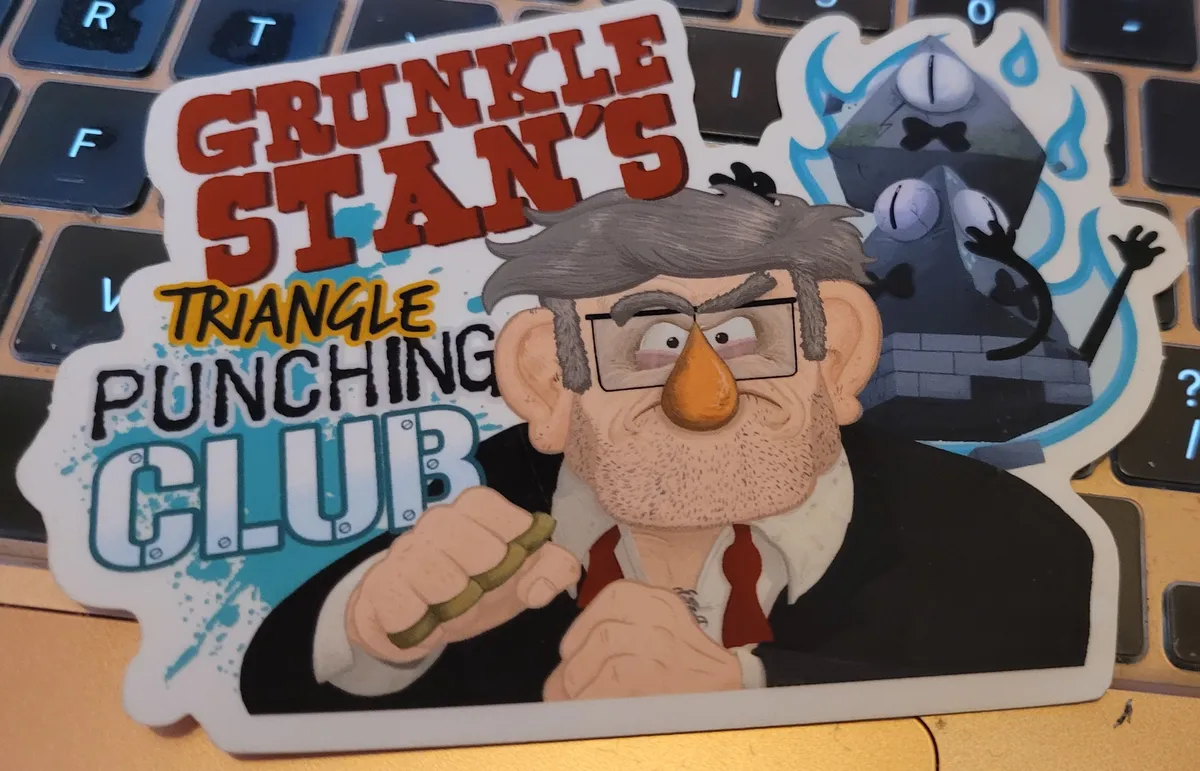
I bought Not S&P Approved's Every Day I'm Grunklin' sticker, and I also got this amazing Triangle Punching Club sticker as a bonus.
I like to think that blockchain is a triangle. It's definitely a pyramid scheme. And I am definitely a proud member of a triangle punching club.
References
Petrick, I. & Simpson, T. (2013) 3D Printing Disrupts Manufacturing. Research Technology Management, 56(6). 12-16. https://doi.org/10.5437/08956308x5606193
Rayna, T., Striukova, L., & Darlington, J. (2015) Co-creation and user innovation: The role of online 3D printing platforms. Journal of Engineering and Technology Management, 37. 90-102. https://doi.org/10.1016/j.jengtecman.2015.07.002
Thingiverse. (n.d.) Thingiverse — The community for Open Hardware. https://www.thingiverse.com [Accessed 12 Jun 2026]
Alibaba.com (n.d.) 3D Printed Dragon with Wings, 3D Dragon 9" Articulated Winged Dragon for Home Office Decor Executive Desk Toys. https://www.alibaba.com/product-detail/3D-Printed-Dragon-with-Wings-3D_1601770864837.html [Accessed 12 Jun 2026]
Farshid, M., Paschen, J., Eriksson, T, & Kietzmann, J. (2018) Go boldly!: Explore augmented reality (AR), virtual reality (VR), and mixed reality (MR) for business. Business Horizons, 61(5). 657-663. https://doi.org/10.1016/j.bushor.2018.05.009
Production Notes. (2019) A whiff of Polyester: Inside the Odorama process. Criterion. https://www.criterion.com/current/posts/6605-a-whiff-of-polyester-inside-the-odorama-process [Accessed 12 Jun 2026]
Jessica the Museum Guide (2026) Ten MORE Must-See Treasures of the British Museum - An In-Depth Guided Tour [Video]. https://www.youtube.com/watch?v=8-PCSUg_juU&t=1121s [Accessed 12 Jun 2026]
Kesteloo, H. (2026) Pokémon Go scans quickly trained the navigation tech now headed into military drones Drone XL. https://dronexl.co/2026/06/09/pokemon-go-scans-niantic-vantor-military-drone-navigation/ [Accessed 12 Jun 2026]
RepRap.org (2025) RepRap https://www.reprap.org/wiki/RepRap [Accessed 12 Jun 2026]