Learning Python, Day 7 — Variables, Type Conversions, and Operators
Yesterday, I had chores to do, taking advantage of the slightly warmer weather to do laundry and go out grocery shopping and all the things that need to get done while the sun shines.
So no Python. But I'm starting the Python Language Fundamentals: Learn Python from Scratch course today, so it's going to be a lot of repetition but hopefully that just means it sticks in my brain a bit more.
00 — Introduction
I like that the list of what I'm going to learn is:
- What makes Python unique
- How to keep track of data
- How to implement logic
- How to implement responsiveness
- How to create data structures
This feels a lot more like what I need to actually start making programs. Also, the topics are:
- Intro to Python
- Variables and operators
- Collection types
- Conditionals and loops
- Functions
- Classes and objects
This is a lot more grown-up than the other one. I liked how the previous course was a bit more ridiculous, but I didn't really learn much that was useful. So I'm hoping this will give me more.
I don't know about the slide style though. That orange....
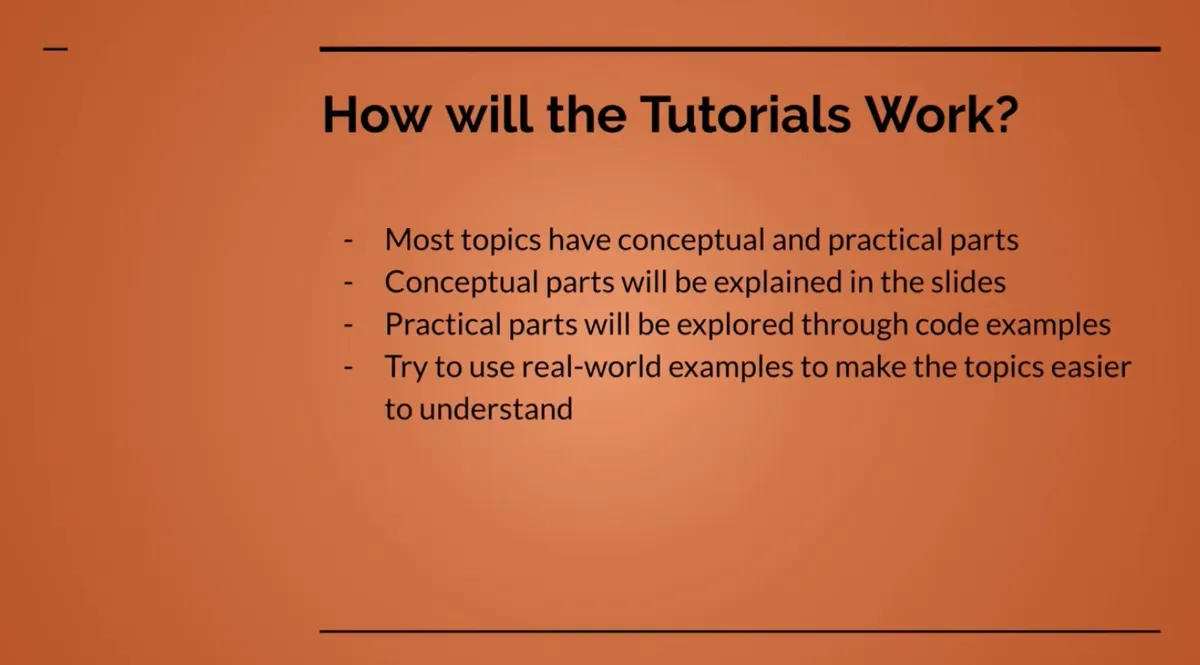
Also, the order of the lessons are all out of whack. Why am I going from "04. Operators" after "0.2 Variables", and then have "02b. Variables Examples"? Why is "Operators Examples" listed as "05" when there's a "02b"? What even is going on and how do I actually keep track of anything?
Ugh, fine, I'll go through it. I really need to find the Mammoth Club course feedback section, though. I have notes.
01 — Introduction To Python
This told me that the course was written in 2019. I'm sure the Python hasn't changed too much, and I'm kinda glad this is all pre-"vibe coding" time. I don't want to learn how to make a bot do my coding, I want to learn how to make a bot do my work through my coding.
02 — Variables
I'm a little annoyed that he said this was for people who weren't programmers, but then he keeps on referring to what other programming languages do. Like, I don't care if other languages use null instead of empty, or "native Double type", or how you have to indicate variables, or whatever, you're just making it a lot more confusing to people by referring to it.
On the other hand, I have now been told that I can use double quotes or single quotes in my strings. I did wonder about that, since the last course didn't mention that at all, and started using single quotes right towards the end.
And he's using underscores in the variables. Woo.
It also included type() which I hadn't seen before. I like knowing there is a way for me to find out what the hell the variable is without me to dig through all the code to find it.
Also? "02b. Variables Examples" was included in "02. Variables". And they repeat the video after "04. Operators". Come on, people, a little bit of quality control goes a long way.
03 — Type Conversion Examples
I'm not 100% sure why you'd want to convert types yet. I'm sure it does serve a purpose, but I'm not seeing it. And it means I have to remember the shortened versions of the types of variables. I already know I'm going to struggle with that, because even replicating the examples he's doing, I keep on going string instead of str.
On the other hand, this is the first time I've actually seen how you comment out code in Python. Oh, precious little #, you are going to save my butt so many times.
04 — Operators
(Oh please don't make me think of BEDMAS again...)
Being able to use arithmetic operators with assignment operators is probably going to confuse me until I really get to repeatedly use them. Like, what on earth does %= give me and why would I use it?
And it's nice to have the fancier names for things. Like, I have never heard of "ternary". I also don't know what Bitwise means for operators, but I guess I'll have to dig into that in a more advanced course.
"05. Operator Examples" appears in the list after "06. Collections" and "07. Lists".
Day 7 — Results
- I like pre-AI-boom coding tutorials.
- I can use single or double quotes for my strings, as long as I stick with one or the other.
- Comment out code using
#at the start of a line. type()tells me what type of variable something is.- The types are shortened to
str,bool,int,float. - To change the type of a variable, use
type(variable). str()will change things to stringsbool()will turn everything intoTrueunless it's0, which will beFalseint()will turn any numbers into integers, but can't turn anything else into integers — you can convert"5"but not"Five"float()will turn any integers into floats, which means you'll get1.0when you convert1.- There are arithmetic, assignment, comparison, and logical operators. Arithmetic is the math, assignment is what you're giving variables, comparison compares them against each other, and logical applies basic "and, or, not" logic to them.
- If/Else is called a Ternary Operator.
- There are also Identity Operators, which tells you what is or is not something, and Membership Operators, which tells you if something is in something else or not.
- You can use arithmetic operators with assignment operators to make things like
**=or+=or//=.
I did think about jumping ahead to "Operators Examples", but, honestly, I'm already a bit fried due to Type Conversions, so I think I'll probably just rewatch "Operators" next time before:
- Operators Examples
- Collections
- Lists
- Multidimensional List Examples
- Tuples Examples
- Dictionaries Examples
I'm still annoyed by how everything is out of order, and I still think he needs to stop referring to other programming languages, but overall, I have learned a bit more. Which is nice.
Today's Sticker
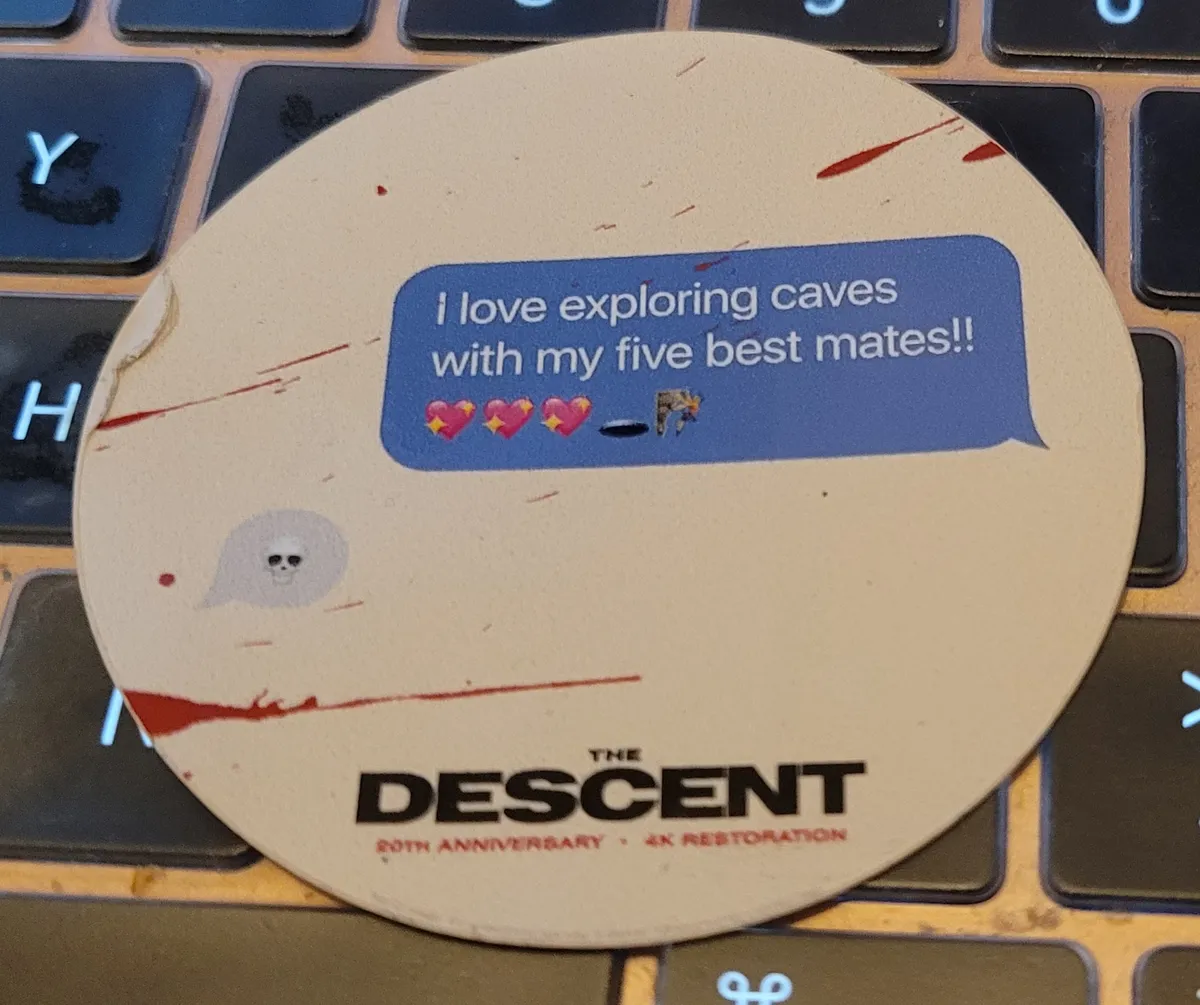
A sticker released for 20th anniversary re-release of The Descent that I picked up at the Broadway. (I didn't see The Descent at that time, but I still love that movie.)